

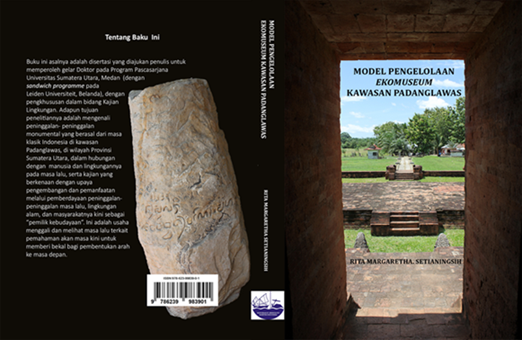
Writers : Rita M. Setianingsih-2022
ISBN : No. 978-623-99839-0-1, xx +225 hlm.; 14.8 cm x 21 cm
Version : Paperback
Language : Indonesia
Publisher : Tangerang Selatan – Masyarakat Arkeologi Maritim Indonesia – 2022
Citation : Rita Margaretha Setianingsih, Lucas Partanda Koestoro, Stefanus (2022). Model Pengelolaan Ekomuseum Kawasan Padanglawas
Summary:
The book was originally a dissertation submitted by the author to obtain a Doctoral degree at the Postgraduate Program of the University of North Sumatra, Medan (with a sandwich programme at Leiden Universiteit, the Netherlands), specializing in Environmental Studies. The purpose of the research is to identify monumental relics from the classical period of Indonesia in the Padanglawas area, in the province of North Sumatra, in relation to humans and their environment in the past, as well as studies related to development and utilization efforts through empowerment of relics of the past, the natural environment, and its current society as “owners of culture”. In Indonesia, the development of archaeology has currently experienced quite rapid progress. Crossing the boundaries of scientific disciplines also occurs in the context of its development. Therefore, the implementation of the analysis has also used approaches from various branches of science, both those included in social sciences such as sociology, history, anthropology and others. This also includes the use of geological and physical sciences. As for archaeology with the field of study of temples and temple sites and other relics from the classical period of Indonesia (also known as the period of Hindu-Buddhist cultural influence), in Indonesia it is part of historical archaeology, of course it requires historical, philological, and other approaches because it also concerns written data. In this regard, at more advanced levels of study, other disciplines must be covered and mastered by archaeological researchers. This will certainly produce interdisciplinary studies such as archaeology-ecology, archaeology-economics, archaeology-history and archaeology-architecture. This is an effort to explore and see the past related to understanding the present to provide provisions for forming a direction for the future.
 masyarakat arkeologi maritim indonesia