

Public awareness and concern for cultural heritage have been stereotyped as “worshipping” the objects in museum displays. The most genuine concern is if the cultural heritage has benefits and value in its use.

It will be different from the context of objects that are national collections or even private collections. Cultural heritage in the form of objects does not have to experience a dichotomy as cultural heritage. Cultural heritage is a legal status for an object.
The public (read in a broad sense) both governance ecosystems, lay people, commercial and non-commercial industries, entity segmentation including individual actors will continue to build contestation of understanding, knowledge correlation relations and also the dominance and resistance of understanding. But what is certain is that understanding of cultural heritage in the context of material and non-material will not stagnate. This understanding will continue to move in accordance with the relevance of global developments.
In the header and footer images of this site, taken from the BnF Gallica collection, with descriptions on the page about the image, there are some interesting things related to what is suspected to be a “Jung” or “Inchi” or in the free language of the Nusantara ship that is in the Indian Ocean and the Arabian Sea. The inscription on the map is as follows:
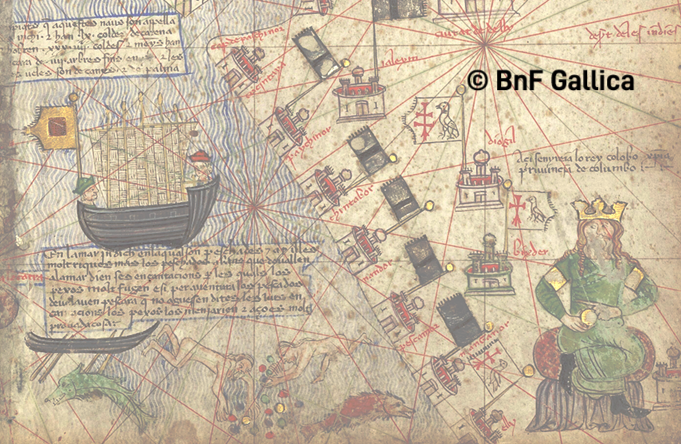
Part of a Catalan atlas depicting a five-masted Javanese junk (Java jong) in the Arabian Sea, 1375 with the following upper inscription; “Sapiats que aquestes naus són appellades Nichi e han ·LX· coldes de carena e hobren ·XXX·IIII· coldes e menys han encara de ·IIII· arbres fins en ·X· e les [lurs] veles són de canes e palma”. With free translation: Know that these ships are called “inchi” and have sixty-cubit hulls with thirty-four cubits of freeboard. They have on top of this between four and ten masts, and their sails are of canes and palm. Note : Inchi is a copying error of jũchi, or junk, from Javanese jong.
while the inscription at the bottom is still from the same source; “En la mar Indich en la
qual son peschades les perles ay illes molt ri ques mas los peschadors abans que devallen à la mar dien ses encanta cions per lesquals los pexes molt fu gen e si per aventura los pescadors devalaven pescare que no aguessen dites les lurs encantacions los pexos los menjarien E aço es molt provada cosa” With free translation: In the Indian Sea where pearls are fished there are very rich islands. The fishermen before going down into the sea make their enchantments by which they make the fish flee, and if by chance the fishermen descend before having made their enchantments, the fish would eat them, it is a very proven thing.
 masyarakat arkeologi maritim indonesia